Introducing the Neo-Security Architecture
On this page
The Neo-Security Architecture is a modular and open-standard-based security architecture. It aims to secure, protect and assert legitimate access to APIs and services as well as to applications both on web and on mobile. A centralized system for managing identities, token issuance, federation and related capabilities is critical to building a secure and scalable API platform.
The primary goal of the Neo-Security Architecture is to provide a blueprint architecture that can be used to map new and existing systems against the functions needed to scale securely. It is not intended to be implemented as a whole but rather to be used as a road-map to be prepared when new needs arise.
The Foundations
The main design principle of the Neo-Security Architecture is Separation of Concerns. Each subsystem within the architecture has a singular responsibility, which helps architects map a problem onto an architectural solution.
The second principle of the Neo-Security Architecture is to build on standards. Each function should use the appropriate standards available to integrate with edge applications or internally. This enables easier replacement of components and helps asserting that security is maintained.
The Neo-Security Architecture has five pillars:
- An Identity Management System
- An API Management System
- An Entitlement Management System
- An Machine Identity Management System
- A Security Operations System
Each of these encapsulate a system function that is loosely coupled with the others. Together the pillars and their subsystems enable secure access for users and applications to APIs. At the heart of the architecture is the Identity Management System, that is responsible for asserting identities to other systems using security tokens.
The Neo-Security Stack of Open Standards
The following is a non-exhaustive list of open standards used in the architecture. The purpose is not to restrict the architecture, but to understand how to adopt security standards vetted by many experts, and the problems that they solve for enterprises.
| Pillar | Subsystem | Standards |
|---|---|---|
| Identity Management System | Authentication Service | WebAuthn, Passkeys, FIDO, HOTP, TOTP and non-standardized methods |
| Federation Service | SAML, WS-Federation, OpenID Connect | |
| User Management Service | SCIM | |
| Machine Authentication Service | HTTP Basic Authentication (shared secret), mutual TLS, JWT-based credentials, HTTP signatures | |
| Token Service | OAuth 2.0, OpenID Connect and JWT-based access token | |
| API Management System | API Security Service | OAuth 2.0 (Introspection, Token Exchange) |
| Developer Portal | DCR and DCRM | |
| API Integration Service | Service mesh | |
| Entitlement Management System | PDP and PEP | AuthZen |
| Policy Administration | ALFA, XACML, Rego, Cedar | |
| Machine Identity Management System | * | SPIFFE, WIMSE, X509 Certificates, JWK |
| Security Operations System | SIEM | OpenTelemetry, Syslog, SET, SSF |
| TDR | CAEP, RISC |
Some of the standards listed are large sets of specifications. Often only parts of a standard are sufficient to solve functional requirements.
The Identity Management System
The main responsibility of an Identity Management System (IMS) is to handle and describe identities within the system. This means it needs to be capable of directly authenticating users as an Identity Provider (IdP) or by using a Federated Identity via another IdP. It also needs to be able to authenticate applications and describe their identity.

No matter the user, whether they are a customer, employee or partner (or whatever user type you may have), the Identity Management System provides a consistent interface for the identities. By authenticating both humans and machines, it is in the unique position to combine identity assertions in a single security token, and maintain trails about delegations.
The resulting security or access token has a crucial role for least-privileges access. It is a short-lived message credential for API requests that conveys to the API Management System enough claims so that it can determine the scope of access for the particular request concerning both the user and application. From this perspective, the Identity Management System, IMS, is delegating access from the user to the application on their behalf. This is a base principle in the OAuth specification.
Since the access token is short-lived, the Neo-Security Architecture enforces a constant refresh and reevaluation of the grant, reducing the risk of over-privileged and standing permissions. As part of an reevaluation, the Identity Management System can, for example, reduce the scope, transform or revoke tokens and access.
The Identity Management System incorporates the following subsystems.
| Subsystem | Function |
|---|---|
| Authentication Service | IdP - Authentication |
| Federation Service | Federating identity across domains |
| User Management Service | User provisioning and management |
| Machine Authentication Service | Authenticating non-human identities |
| Token Service | Secure token issuance and introspection |
The API Management System
The API Management System (AMS) is the logical structure of an API deployment. Its purpose is to service data and functions via APIs and other types of services in a secure manner.
There are three distinct functions of an AMS that are represented in this architecture.
- Securing access to APIs
- Integration of APIs into services
- Developer access to APIs
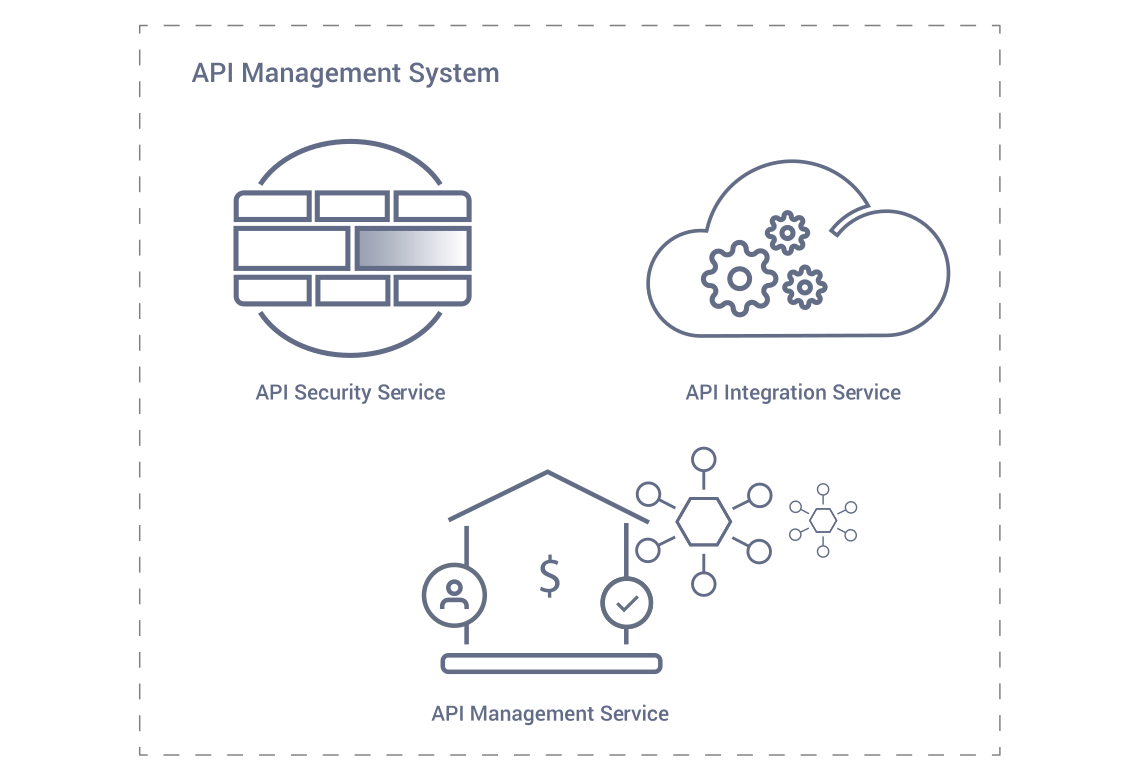
At a bare minimum, organizations need to secure access to APIs. For this, the API Management System (AMS) depends on the Identity Management System for all identity related operations, and for issuing the access token.
The API Management System incorporates the following subsystems.
| Subsystem | Function |
|---|---|
| API Security Service | Securing access to APIs |
| API Developer Portal | Developer access to APIs |
| API Integration Service | Integration of APIs into services |
The API Security Service of the API Management System can handle some security concerns on behalf of APIs (microservices). The API Security Service then acts as the police, using identity information from access tokens to enforce access policies. See also the Identity and Access Management Primer for more technical details on how to secure access to APIs.
The Entitlement Management System
Organizations need a strategy for managing many authorization rules. Such a strategy should account for policy reuse and the ability to change some types of authorization rules dynamically. This is where the Entitlement Management System (EMS) comes into play.
The Entitlement Management System is responsible for managing and enforcing authorization policies as well as distributing these to each subsystem that needs enforcement. It enables central policy administration and decentralized enforcement, where the the API Management System with its API Security Services plays a central role in enforcing the policies.
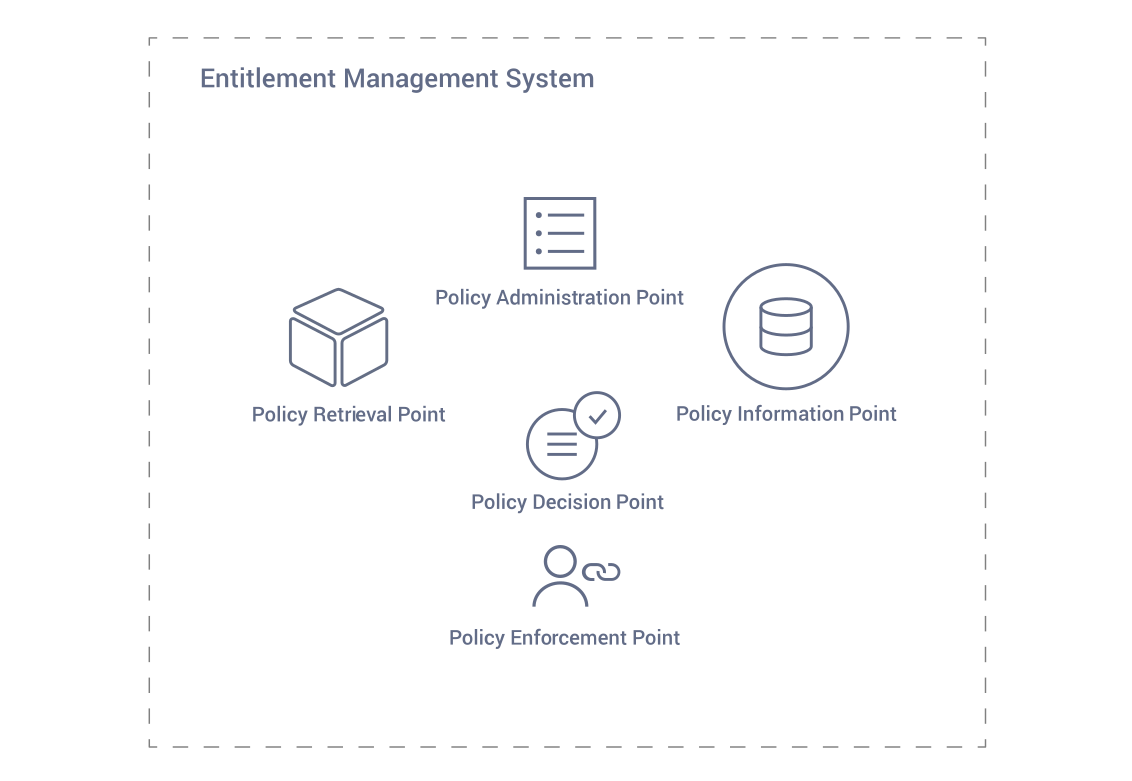
While the Identity Management System pulls out identity-related logic from APIs, the Entitlement Management System pulls out authorization-related logic. This approach is also known as policy-based access control. The benefit is that authorization policies can be added and updated as the business requirements evolve.
For highly regulated and valuable data, the Entitlement Management System usually applies fine-grained policies with attribute-based access control (ABAC). In this way, it can validate users with their current context (such as the network or device), their client applications (like a mobile app or web app) and their requested actions besides their roles and other attributes.
| Subsystem | Function |
|---|---|
| Policy Administration Point (PAP) | Create and manage authorization policies |
| Policy Retrieval Point (PRP) | Distribution of policies |
| Policy Information Point (PIP) | Enrichment of attributes |
| Policy Decision Point (PDP) | Resolves an authorization request to allow or deny |
| Policy Enforcement Point (PEP) | Enforces decision made by the PDP |
The Machine Identity Management System
The Machine Identity Management System is the identity provider for machine identities. It defines the means for machines (software) to authenticate to other machines to secure machine-to-machine or service-to-service communication. The primary responsibility of the Machine Identity Management System is the lifecycle management of digital credentials and identity assertions.

Machines like mobile apps, APIs or workloads, AI agents or lambda functions require a secret like a shared secret, an API key or private key to securely communicate with other machines. Where possible, the Machine Identity Management System replaces shared secrets with digital credentials and related private key material. It automates the creation, rotation and revocation of these digital credentials and related secrets, which enables short-lived credentials to minimize the risk of stolen credentials.
As part of the issuing process, the Machine Identity Management System can also utilize software attestation to only issue credentials to accredited software. Many SPIFFE-compliant implementations, for example, support attestation-based issuance. X509 certificates or JWT-based assertions.
The Identity Management System integrates with the Machine Identity System to authenticate machines. It then represents their identities in security tokens, commonly next to human identities.
| Subsystem | Function |
|---|---|
| Workload Identity System | Workload attestation and credentials management |
| Secret Vault | Secure storage of shared secrets |
| Registry | Visibility, accreditation of machine identities |
The Security Operations System
Organizations need to have tools to understand secure access at scale. The Security Operations System adds oversight to the architecture. Its main responsibility is to provide visibility that allows for getting insights into previous and current security state within the Neo-Security Architecture.

The Security Operations System gathers and pulls together data from the different systems in the architecture. This allows for monitoring, analyzing and responding to suspicious findings. A basic form of response are alarms and user notifications.
In a proactive setup, the Security Operations System signals events to the Identity Management System, the Entitlement Management System and API Management System so that they automatically adapt and assist in mitigating threats, e.g., by revoking access. The same systems also send signals to the Security Operations System for aggregation and analysis.
| Subsystem | Function |
|---|---|
| Log Aggregation System | Collecting logs |
| Security Information and Event System | Log and event analysis through security lense |
| Threat Detection and Response System | Detect and act upon suspicious events or behavior |
| Discovery | Visibility of unmanaged actors or actions |
Conclusion
The Neo-Security Architecture is built on open standards that are accepted and adopted by the market. The Neo-Security Architecture emphasizes Separation of Concerns by defining dedicated services. Because each service is dedicated to its function and loosely coupled to the others through standards, you can update one service independent of another service, making the system easier to manage and develop over time.
The central point of the Neo-Security Architecture is the Identity Management System. The Identity Management system authenticates both users and machines. For the latter, the Machine Identity Management System serves as a complement to the Identity Management. The Identity Management System supplies the API Management System, the Entitlement Management System and the Security Operations Systems with verifiable identity data about users and machines which is relevant and necessary for access control decisions, audits, threat detection and response.
Dive deeper into the pillars of the Neo-Security Architecture in the following articles:
- What is an Identity Management System?
- What is an API Management System?
- What is an Entitlement Management System?


Curity
Customer Stories
Learn how organizations run identity and API security at scale.
Read customer storiesWas this helpful?